
by John Raven, Ph.B.
This month we are going to take a stroll through the sweet and sticky world of jams, jellies and their relatives.
Jam
a sweet, thick concoction made from crushed fruit.
Jelly
Made from the clear juice of fruit or other things.
Marmalade
A jam with bits of citrus peel included.
Conserve
Usually made with two or more fruits and with raisins and nuts sometimes added.
Molasses
Made from sorghum juice.
Corn syrup
Made from corn sugar.
Maple syrup
Made from the sap of the Maple tree. (There are folks in New England with vats in their backyards where they boil maple sap down into syrup as a winter sport much as our barbecues are our summer sport.)
Fruit Preserves
The term preserves means anything preserved, but is often used to describe jams and jellies. Only preservation societies deal with making syrup now days so we will deal with the jams and jellies.
Texas pioneers found native fruits that they made into preserves. Wild mustang grapes were and are still popular for jelly. They also make a killer wine in the right hands. Mesquite bean jelly is more of a conversation piece than a popular condiment, and making it is a long, tedious process. The fruit of the prickly pear cactus makes a decent jelly. Of course, you have to deal with the thorns while collecting them. For some reason, the fruit of the prickly pear is referred to as “tuna”.
Wild plum trees are hard to find nowadays and usually the birds and other creatures get the fruit before it’s ripe enough to make jelly. Elderberries can be found growing along the streams and rivers of Texas. The storied agarita berry plant of the Texas Hills has a small, yellowish berry that is highly favored by many but, alas, the time required to pick a gallon of these berries kinda takes the shine off the finished product. Although not native, blueberries are now being grown in Texas. They grow very large but to me, they are lacking in taste.
We can’t finish here without mentioning honey. Honey is nature’s sweet gift from the honeybee. Nothing is as good as a good helping of clover honey on a buttered biscuit. The invasion of the South American “killer bees” has the native bees on the decline — mainly because it is difficult to tell a native honeybee from a Latin bee, so nearly everyone is against all bees. We are going to have to start taking care of our honeybees, though, because they pollinate nearly every fruit and vegetable on our tables. Without them, we’ll be on an all meat diet.
Jams, jellies and their ilk go best with fresh butter. When I was growing up, “butterbread and jelly” was a favorite after-school snack. My favorite was always plum jelly. In those days, every garden had a plum tree or two.
Pectin is the stuff that makes jams and jellies “jell”. It’s a natural component of fruits and berries. Before pectin was available by itself, making jam and jelly was a long, tedious process. Ripe fruit has less natural pectin than green fruit so you had to add some green fruit to your recipe to get the thing to jell. Now you can get pectin in liquid or powdered form in the canning section of your local supermarket. The powdered pectin is added before the fruit is boiled, the liquid after the fruit is boiling. The liquid pectin is a real time saver.
Now that you are ready to start making your very own jelly or jam, here’s a few things you will need:
- A large pot or kettle at least a gallon in size
- Long handled spoon for stirring
- Measuring devices
- Lots of sugar
- A strainer or a supply of cheesecloth
- Jars to put your jelly in with sealing lids and rings
Get yourself some real canning jars. Don’t try to recycle the jars you get pickles in; they are not designed for reuse and may break when you put hot materials in them. You will also need new lids for the jars to insure a good seal. Read all the instructions before you start boiling anything.
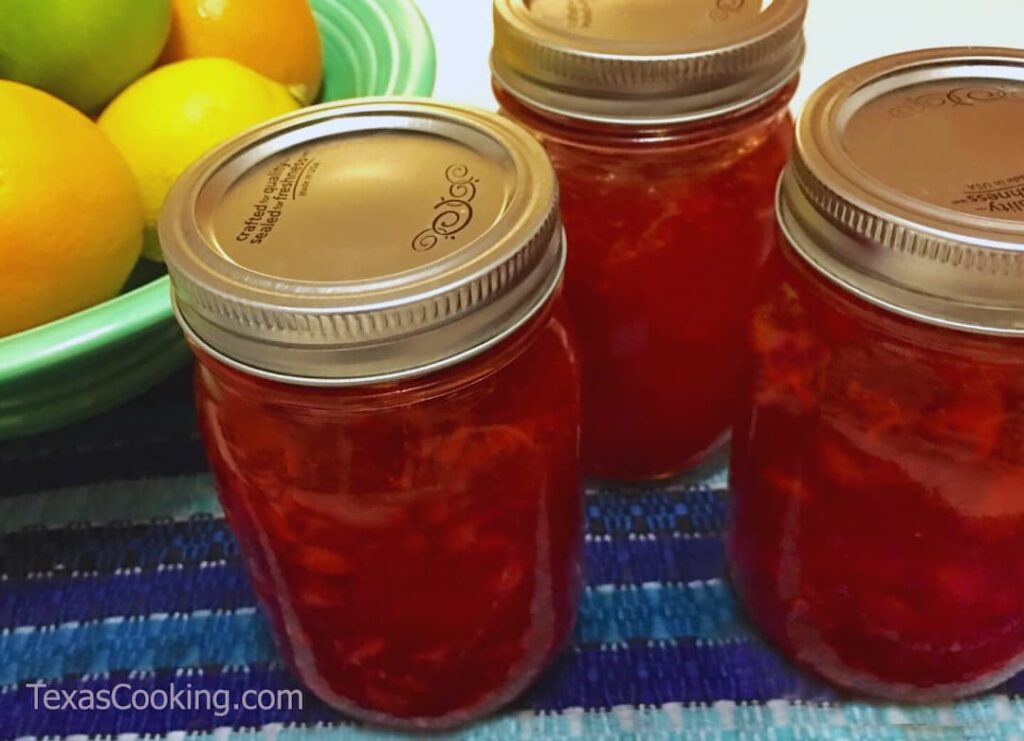
Here are recipes for my “Stop Light Trio” of jellies — green, orange and red. Aside from tasting good, jellies are nice to look at.
Preserve Recipes
- Article: Jams and Preserves
Capture Summer Flavors Making Jams & Preserves - Article: Canning and Dehydrating
Yes We Can! Canning & Food Dehydrating - Blackberry Preserves
- Jo Nell’s Peach Preserves
- Grandma’s Elegant Strawberry Preserves
- Watermelon Rind Preserves
Fresh Mint Jelly
Ingredients:
- 1 cup chopped mint leaves and tender stems
- 1 cup water
- 1/2 cup apple cider vinegar
- 3 cups sugar
- 5 drops green food coloring
- 1 bottle liquid pectin

Preparation:
- Wash the mint leaves well in cold water before chopping them.
- Put the chopped leaves, water, vinegar and sugar in a large pot.
- Over high heat while stirring constantly, bring the mixture to a full rolling boil that cannot be stirred down.
- Add the pectin and food coloring, and bring back to a full boil for one-half minute.
- Remove from heat.
- Skim the foam off the top.
- Strain through a double thickness of damp cheesecloth and put immediately into jars and seal.
Makes 3 or 4 eight-ounce jars.
Orange Jelly
Ingredients:
- 3 cups sugar
- 1 cup water
- 1 bottle liquid pectin
- 3 tablespoons fresh lemon juice
- 1 6-ounce can frozen orange juice concentrate, thawed
Preparation:
- Mix the sugar and water, and bring to a rolling boil that cannot be stirred down.
- Boil for one minute.
- Remove from fire and stir in the pectin.
- Add the orange concentrate and mix well.
- Pour into hot jars.
Makes 4 or 5 eight-ounce jars.
Jalapeño Pepper Jelly
Ingredients:
4 to 6 large jalapeño peppers
4 green or red bell peppers
1/3 water
1 cup apple cider vinegar
5 cups sugar
1 6-ounce bottle fruit pectin
Green or red food coloring
Preparation:
- You have to first determine whether your want your jalapeño jelly to be red or green. If you choose red, then use red bell peppers and red food coloring. If green, well, I’m sure you can figure out the rest.
- Seed and devein all the peppers, and roughly chop them.
- Purée the peppers in a blender with the water. You may need to make more than one batch, depending upon the size of your blender.
- Combine the pepper purée, vinegar and sugar in a kettle and boil slowly for 10 minutes.
- Add the pectin and food coloring, and bring to a boil.
- Pour into hot jars.
The kids may not care for the jalapeño jelly, but we can’t have a whole world devoted to twelve year olds. The jalapeño jelly is great on cold roast beef or used as a glaze on your grilled chicken. And if guests arrive unexpectedly, put out an 8-ounce block of cream cheese covered liberally with jalapeño jelly. Serve with corn chips. It’ll be a big hit.