
By Sidney Carlisle
Back in the good old days, bread was made at home. No one had the money to buy bread, even if it were available at the local grocery. A cook would set aside one or two days a week to make several loaves, supplementing with biscuits or corn bread between baking days.
Most bread was made with white flour, although some households also kept wheat on hand. When times were hard and money was scarce, one sack of flour usually had to work for everything, whether bread or cake, so white flour was the more versatile choice.
Sponge and Dough
To begin preparations for bread baking, the baker “set a sponge” on the night before. (If you’re under 50, you need to understand that a sponge is not yellow and stuck to one end of a mop.) The sponge consisted of flour, water and yeast. These ingredients were mixed with a spoon, covered with a tea towel or perhaps a blanket if it were the dead of winter, and left to set overnight. The yeast would ferment and produced a bubbly batter that smelled good. The next morning the rest of the bread ingredients were added to the sponge, forming a dough to be kneaded and set to rise as usual.
The sponge process adds tremendous flavor and texture to bread. It is the equivalent of an extra rise in the bread making process. Bread made without a sponge usually rises twice, once after it is mixed and once after it is shaped. Most heavy-crusted, old-world style breads are made with a sponge, also called a biga or starter. These breads, termed “artisan” by professional bread bakers, have a developed yeast flavor that is difficult to achieve in bread that has risen only twice.
Let’s Get Started
Making a sponge is simple, if you can remember to prepare it the night before you want to bake bread. It takes only about five minutes to stir the ingredients together. Most recipes will indicate how long to let the sponge set. The longer the time, the more developed the flavor will be.
When ready to prepare the dough, stir the sponge gently and then add the remaining ingredients. The consistency of the sponge will vary, depending on the length of time it has set, the humidity in the room, and the temperature. The amount of flour may need to be adjusted, whether the dough is made by hand or in a bread machine. Add the minimum amount of flour indicated in the recipe. If the dough is too sticky, add one tablespoon at a time until it has absorbed enough flour to be easily kneaded.
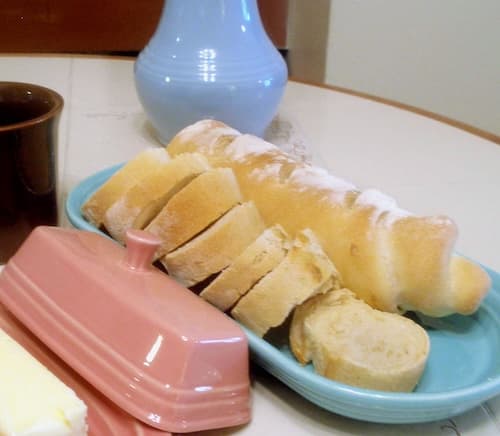
The two recipes that follow produce flavorful, artisan-type bread loaves. The dough for either recipe may be prepared by hand, or by using the dough cycle of a 1-1/2 to 2 pound capacity bread machine. The process is easy and the bread is wonderful.
Italian Bread – Sponge Method
(Please note that this recipe uses all-purpose flour, rather than bread flour.)
For the sponge:
- 1-1/2 cups all-purpose flour
- 1-1/2 teaspoons active dry yeast
- 1 cup lukewarm water
Combine the flour and yeast in a mixing bowl. Stir in the water. The mixture will be very thick. Cover with plastic wrap or a cup towel and leave at room temperature for 4 hours or overnight, but not longer than 12 hours.
To prepare the dough:
- 3 tablespoons lukewarm water
- 1-1/2 teaspoons salt
- 1-3/4 cups all-purpose flour, approximately
Add the water and salt to the sponge. Stir in the flour, adding an extra tablespoon or two of flour if the dough seems sticky. Knead until smooth and elastic, about 8 minutes. Place the dough in a greased bowl and cover with plastic wrap. Let rise until doubled in size, about 1-1/2 hours. (If using a bread machine, dump the sponge in the pan and add the other ingredients. Select dough or manual cycle. Leave the top of the machine up, and watch as the dough forms. Add flour if needed. Put the top down and let the machine continue to mix, knead and complete one rise.)
Punch the dough down and divide in half. Shape into two rectangles. Roll one rectangle from the long side and pinch the seam together with your fingers. Repeat with the other rectangle. Leave the two loaves on the work surface and cover with plastic wrap for 30 minutes.
Preheat the oven to 425 degrees. Grease a baking sheet with shortening. Pick up each loaf and stretch gently as you place it on the baking sheet. Sprinkle the loaves lightly with flour. Cover again and let rise 20 minutes. Using a serrated knife, cut three or four diagonal slashes about 3/4-inch deep across the top of each loaf. Bake about 20 minutes, until lightly browned. Cool 15 minutes before cutting.
As this is a fat-free bread, it has a short shelf life. Use it on the day it is prepared or freeze in plastic freezer bags. To reheat, thaw on the counter in the bag. Remove from the bag and heat 8 to 10 minutes on a baking sheet in a 350-degree oven.
Bread Recipes
- Making Cornbreaad
With many cornbread recipes - Biscuits All Day Long
Making biscuits - How to Make Your Own Flour Tortillas
- Bread Spreads
by John Raven, Ph.B. - Dish Bread Recipe
French Peasant Bread
A crusty, old-world style peasant or farm bread.
For the sponge:
- 1/2 cup wheat flour
- 1/2 cup bread flour
- 1-1/2 teaspoons active dry yeast
- 1/2 cup water
- 1-1/2 teaspoons dark corn syrup
Combine the two flours and the yeast in a mixing bowl. Add the water and corn syrup and stir until well blended and fairly free of lumps. Cover loosely with plastic wrap or a cup towel and allow to stand at room temperature overnight.
To prepare the dough:
- 3/4 cup water
- 1-1/2 teaspoons salt
- 3/4 cup wheat flour
- l-1/2 cups bread flour, approximately
Add the water, salt and wheat flour to the sponge. Stir in the bread flour, adding an extra tablespoon or two if the dough seems sticky. Knead until smooth and elastic, about 8 minutes. Place the dough in a greased bowl and cover with plastic wrap. Let rise until doubled in size, about 1 hour and 45 minutes.
Peasant Bread for the Bread Machine
Dump the sponge in the pan and add the other ingredients. Select dough or manual cycle. Leave the top of the machine up and watch as the dough forms. Add flour if needed. Close the lid and let the machine continue to mix, knead and complete one rise. At the end of the cycle, turn off the machine and let the dough continue to rise for 45 minutes. If your machine has an automatic knead-down cycle, set a timer and turn the machine off prior to the knead-down.
When the first rise is complete, punch the dough down. Shape into a smooth round ball or an oval. Flatten slightly with your hands. Place on a greased baking sheet that has been sprinkled with cornmeal. Cover with wax paper and let triple in size – 2 to 2 1/2 hours.
Place an empty aluminum pie plate on the bottom oven shelf. Preheat the oven and the pan to 425 degrees. Five minutes before adding the bread, carefully pour 1 cup hot water into the pan. This causes a big burst of steam, so use an oven mitt and be careful.
Sprinkle the loaf with flour. Using a serrated knife, cut 3 diagonal slashes across the surface of the loaf. Bake 30 to 35 minutes, until golden brown. Remove from the pan and cool on a wire rack.
This, too, is a fat-free bread. Use it on the day it is prepared, or freeze in plastic freezer bags. To reheat, thaw on the counter in the bag. Remove from the bag and heat 8 to 10 minutes on a baking sheet in a preheated 350-degree oven.
Sidney Carlisle lives on a ranch in Meridian, Texas.